

Myopia Control in Children
Myopia (commonly called ‘shortsightedness’) is becoming more common in children, with the prevalence among Australian 12 year old’s doubling in 6 years. By 2050, it is estimated that approximately 50% of the world’s population will be myopic.
Typically, myopia occurs when the eyeball grows too quickly in childhood, or when the eye continues to grow when eye growth should normally stop. Unfortunately, myopic changes are permanent and in turn can increase the life-time risk of sight-threatening conditions such as glaucoma, retinal detachment, cataracts and myopic macular degeneration. However, research is showing there are strategies to slow or prevent the progression of myopia in children.
Cooper & Lourie Family Optometrists offers children and young adults comprehensive myopia consultations. Our optometrists will perform thorough assessment and examination and discuss the best evidence-based treatment option to minimize myopic progression for you or your child.
Myopia Control Options
Ortho-Keratology
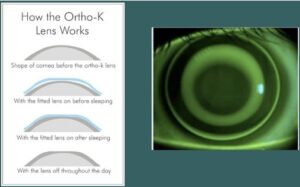
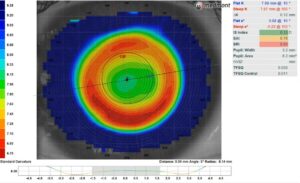
Orthokeratology (Ortho-K) lenses are specially designed rigid contact lenses that are worn overnight. They reshape the cornea to restore normal vision in the morning. The lenses provide clear vision on the central retina, while the peripheral retinal image moves in front of the retina – this sends an optical ‘stop signal’ to the eyeball to slow down its growth. Using Ortho-K lenses have been shown to reduce myopia progression by approximately 50%.
Multifocal Disposable Contact Lenses
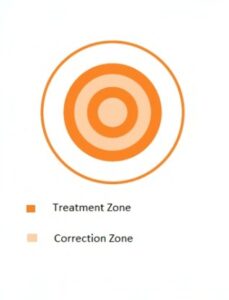
Soft multifocal contact lenses such as MiSight by Coopervision and Abiliti by Johnson and Johnson are worn during the day. These lenses have a customized profile which provides the ‘stop signal’ to the peripheral retina. The use of multifocal contact lenses can slow down the rate of myopia progression by approximately 50%
MiyoSmart
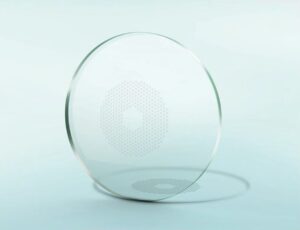
The MiyoSmart spectacle lens is a special single vision lens created by HOYA. The lens is designed by incorporating hundreds of small lens segments that provide the ‘stop signal’ while maintaining clear central vision. This lens is designed for full time wear and it has been shown this lens reduces myopia progression by approximately 50%.
Atropine
Atropine eye drops are normally used to make the pupil bigger and to prevent the eye from changing focus. Recently, however, research has shown that very low strength Atropine can slow myopia progression by approximately 50% by providing a chemical ‘stop signal’ to the eye. We provide a written prescription for low strength atropine which needs to be a special order through a compounding pharmacy. Drops are taken once per day before bedtime, spectacles or contact lenses still need to be worn during the day to correct the vision.
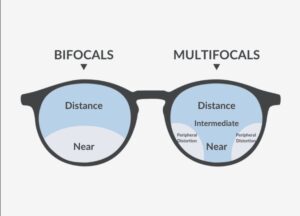
Bifocal/Multifocal lenses
Bifocal or Multifocal lenses are less effective in controlling myopia. However, in a small group of children who have a tendency to ‘overfocus’ or ‘cross’ their eyes with near work they show approximately 20-30% reduction in myopia progression.
What is myopia?
Myopia, commonly called shortsightedness, is a condition in which light is focussed in front of the retina, resulting in blurred vision. Shortsighted people can often see reasonably clearly at short distances, but will not be able to see distant objects clearly. There is currently no cure for myopia, but spectacles, contact lenses and refractive surgery can all provide good distance vision for people with myopia.
How can I tell if I am shortsighted
Shortsighted people have difficulty in seeing distant objects clearly. They find it hard to read road signs and scoreboards and to play ball games. Recognising people in the distance may be a problem for many shortsighted people. Often a person will not realize that they cannot see clearly but an eye examination by an optometrist will reveal the problem.
How can I tell if my child is shortsighted
A complete eye test is the only sure way of determining whether your child’s vision is normal. Some clues to myopia in a child are:
- screwing up eyes to see distant objects;
- difficulty reading the blackboard at school;
- poor posture while reading; and
- lack of interest in playing outdoor games.
What causes myopia
The exact causes of myopia are not known. At various times people have blamed excessive amounts of reading, poor metabolism, poor diet, poor light, poor posture and genetic factors. Recent research has shown that the development of myopia is influenced by both genetic and environmental factors.
Can myopia be cured
Despite ongoing research, a cure for myopia has not yet been found. Properly prescribed spectacles or contact lenses will enable a person with myopia to see clearly. Laser surgery to reshape the front surface of the eye can also help some people with myopia. Your optometrist can advise you about the latest developments and whether they would be suitable for you.
Can myopia be prevented
There is no certain prevention for myopia, however recent research has found that there are a number of strategies that slow the progression of myopia in children. Research is continuing and evolving in this field. Book in to have a discussion with one of our optometrists to discuss myopia control options.
How common is myopia
It is a very common condition. About 25 per cent of the Australian population is shortsighted. Usually myopia begins to develop in teenage years and it may get worse over the following few years.